LIBERAL ENVIRONMENTALISM’S DEEPEST DARKEST SECRET

LIBERAL ENVIRONMENTALISM’S DARK SECRET IS THAT IT DOESN’T WORK, AND IT’S NOT ABOUT THE ENVIRONMENT.

Environmentalists (the liberal variety) are taking a lot of hits these days. Their ability to keep us from drilling for our own oil is being blamed for $4 plus gas prices. Their refusal to allow any substantial increase in large-scale energy production is being blamed for serving as a straitjacket for our economy and our prosperity. Their manufactured “global warming” crisis is being blamed for institutionalizing the shortages mentioned above and for threatening to put aspects of our lives, from the most momentous, such as how many children we have, to the most minute—our home thermostat settings and how much gas we buy—under the control of liberal bureaucrats.

Almost no one, however, takes issue with Liberal Environmentalism’s most basic claim—that protecting nature, i. e. reducing the impacts of humans on forests, grasslands, deserts, meadows, mountains, etc. makes those areas more natural, more healthy, better functioning, and a better home to their native plants, animals, and ecological functions.

Some may gripe that enviros want to protect too much and say “It would be nice of we could protect everything, but…,” but those same people are glaringly quiet beyond that. Even Liberal Environmentalism’s most vocal adversaries have little or nothing to say about whether contemporary environmentalism works to save the bunnies, birds, trees, fishes, and ecosystems that make up what we call Nature.

That is about to change.

Liberal Environmentalism’s deepest, darkest, secret is that it doesn’t work. It doesn’t work to do the one job it claims that only it can do—restore nature, heal the planet, bring back native plants and animals, save endangered species, and so forth. In fact, in many of those cases and more, Liberal Environmentalism doesn’t even make things better, it makes things worse.

That requires an example. A good one involves the Verde River in Central Arizona.

In the mid-1990s a couple of environmental groups sued the U. S. Forest Service to remove cattle from public lands along hundreds of miles of streams in the Southwest including the Verde. They sued because they deemed the impacts of grazing to be a threat to two threatened species, the Verde being home to one of these species—the spikedace. Instead of arguing the suit, the U. S. Forest Service conceded to environmentalists’ demands out of court without the knowledge or agreement of the Arizona Cattle Growers’ Assn. and New Mexico Cattle Growers’ Assn., which were intervenors in the case.

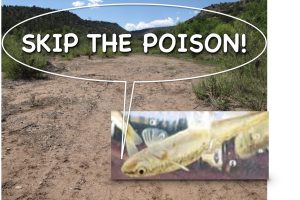
In 1997, after all cattle were removed from the upper stretches of the Verde, to everyone’s surprise, it became apparent that the spikedace had left with them. Monitoring by state and federal agencies has turned up no spikedace in the Verde since grazing along the river was stopped. In fact, the number of all native fishes in the Verde has dropped precipitously since what was alleged to be the major threat to them (grazing) was removed. (from 80% native / 20% nonnative to 20% native / 80% nonnative)

U. S. D. A. scientists, searching for an explanation to this counter-intuitive happening, noted that, after grazing was removed, a large increase in trees and willows began to crowd the riverbanks transforming the stream from wide, shallow, gravelly, and warm (ideal habitat for spikedace and other warm-water natives) to narrow, tree-shaded, mud-bottomed, deep, and cool, which is ideal for large, non-native spikedace-eating predators such as smallmouth bass. And then the big fish ate the little fish.

The Verde River 1975—grazed, wide, shallow, gravelly, and warm, ideal habitat for large numbers of spikedace and other warm-water native fish. The Verde River 2008, grazing has been removed from this area for 15 years, and the river is narrow, tree-shaded, mud-bottomed, deep, and cool, and there are no spikedace.
Small portions of the Verde continue to be grazed. They looked surprisingly like the river did when it was good spikedace habitat.

Small portions of the Verde continue to be grazed. Today, they look surprisingly like the river did when it was good spikedace habitat.

The reduction of human impact on the Verde’s riverside habitat by removing grazing is an application of the assumption that forms the bedrock on which contemporary liberal environmentalism is founded. That assumption is that all environmental problems are caused by the overuse, misuse, or just plain use of nature by humans, and that the way to solve all of those problems, or to avoid them, is to limit our species’ use of nature, ideally to zero.

Some in the environmental movement, quite a few actually, have taken this belief that “humans don’t cause environmental problems, we are the problem” to its logical extreme. For instance, when University of Texas evolutionary ecologist and lizard expert, Dr. Eric Pianka, the “2006 Distinguished Texas Scientist,” advocated the elimination of 90 percent of Earth’s population by airborne Ebola. He was given a standing ovation by the Texas Academy of Science. More environmental writers than I can (or want to) quote here have said that the best thing that could happen to planet earth is for homo sapiens and our impacts to disappear.

HOLD THE EBOLA

In the case of the Verde River’s spikedace and its other native fish, the removal of human impacts seems to have been the worst thing that could happen. If that result doesn’t disprove the basis for contemporary liberal environmentalism, it at least raises significant questions about it. It certainly helps make the case that mainstream environmentalism doesn’t work, at least not all the time, because Big Green not only didn’t achieve its goal of protecting the spikedace, it exterminated a significant population of the rare fish. And without so much as an “oops” or “sorry” to boot.

If that surprises you, it‘s just the beginning of the story of Big Green’s failure in the case of the Verde and the spikedace. It gets worse.

Note: This was first posted on my “Learner Blog” – rightway2bgreen.blogspot.com

WHY I CHANGED

A reader asked that I explain why I changed from a liberal to a conservative environmentalist. A good explanation is offered in an adaptation of an editorial I wrote that was published by the Writers on the Range syndicate of the High Country News. It, too, was called…

THE RIGHT WAY TO BE GREEN

By Dan Dagget

The presidential election is approaching, and as usual the environment is an issue considered to be owned by the liberals, which, in this case, includes even the presumed Republican candidate.

 I would have had no problem with that when I was fighting strip mines in Ohio in 1973 and environmentalism was synonymous with leftist politics. In the early 80s, when a friend told me someone named Dave Foreman was forming an environmental group named Earth First! that would be so far to the left it would push the entire debate in that direction, I was among the first to show up.

 As I have become older and more experienced, however, I’ve come to believe the exclusive connection between the left and the environmental movement is neither good for the environment nor for environmentalism.

 The main reason for this change of mind and heart is I’ve become convinced the private-sector really is more effective than government at producing just about anything, healthy ecosystems included. I came to this conclusion for the usual reasons-the failure of the Soviet Union and other public-sector flops. More important, however, was the fact that, in thirty years of activism, the most impressive environmental successes I have encountered were achieved by private individuals operating according to principles that make up the conservative playbook. In each of those cases individual initiative, personal accountability, the free market, and rewards for results were more effective at saving endangered species, healing damaged ecosystems, even combating global warming than the government alternative-regulation and protection.

 These successes even got me to thinking that the reason environmental problems seem so hard to solve may be because the leftist methods we use to deal with them are so ineffective.

 And isn’t Nature a conservative? After all, she rewards success not compliance.

 Put all of this together, and it adds up to a significant question: Why have environmentalists chose the leftist approach, which is a confirmed loser and unnatural to boot, over an approach based on conservative principles that is proven to be more effective? The answer came when I took those success stories to my environmental peers.

 I knew how most environmentalists feel about everything conservative, so, when I told them that I was coming to believe conservative principles offered a better way to a more effective environmentalism, I wasn’t surprised by their chilly response. What did surprise me was their total lack of interest in how people they normally think of as adversaries had succeeded in dealing with problems that had stymied them for decades. 

 After a few years of this, I was the one who finally got the message. I concluded that many of those who call themselves environmentalists are more interested in imposing leftist prescriptions than in achieving success on the ground. For them, environmental issues are a means to achieve liberal political ends rather than the other way around. In fact, that’s how many environmentalists measure success—in the number of acres brought under government control, in laws passed, in regulations created, and in the election of politicians committed to increasing all of the above. My environmental listeners weren’t interested in the successes I described to them because those successes weren’t achieved by leftist means and didn’t further leftist agendas.

 That realization convinced me of the need for a conservative alternative to liberal environmentalism. Liberals deal with problems by applying policies–a living wage, affirmative action, universal health-care, wilderness designation. Conservatives, on the other hand, work to create a situation in which people can use their creativity and initiative to produce a product for which there is a demand and, therefore, a reward. An environmentalism based on conservative principles would determine success and dispense rewards for achieving results—environmental results, not for applying policies.

 That would change the face of the environmental debate entirely. First, it would give people on the right, many of whom are as concerned about real environmental problems as liberals, an environmental strategy to support that did not require them to sign on to something they oppose—increased regulation and bigger government.

 Second, it would give true environmentalism—an environmentalism directed at achieving results, not applying policies—a frame of reference through which it can make sense to the rest of us. At present that is not the case.

 What I mean by this is: there are plenty of environmental successes out there that have been achieved by conservative means. In fact, there are probably more conservative environmental successes than liberal ones—if you measure success in terms of results achieved rather than policies applied. You probably haven’t heard of those successes, however, but don’t be surprised. In the rare case that conservative environmental successes are reported by the mainstream media they are reported as anomalies, as oddball events, as “man bites dog” rather than as achievements in a larger context.

 When the media reports liberal environmental achievements, such as laws passed, regulations tightened, or land withdrawn from use, they are invariably presented as a step in the right direction, as progress, as part of a continuing story. We are reminded how bad things were yesterday, how progress is being made slowly but surely, with great and heroic effort, so we look forward to tomorrow and the next installment in this unfolding saga.

This wouldn’t be so bad if the conservative media reported the other side of the story, as it has on, say, the Iraq War. However, the conservative media treat conservative environmentalism just as badly if not worse than the liberal media. Since conservative pundits view environmentalism as a purely liberal phenomenon, they refer to environmentalists as “wackos,” work to debunk or diminish environmental issues, and treat conservatives who express concerns about those issues as candidates for “deprogramming.”

 And yet, if conservative environmental successes are going to be reported anywhere, in the conservative media is where it is going to have to be. These successes don’t fit the liberal template, nor do they advance the liberal agenda, so they will never be reported other than peremptorily in the liberal media.

Creating a conservative environmentalism would give the right wing media a context in which to report conservative environmental successes, and thus, the incentive to do so. It would create a story, with conservatives as the heroes and conservative achievements as the victories, that the talk shows could update every day, just as the liberals currently update global warming.

 That would mean that, for the first time,…

  • the fact that conservative approaches regularly outperform liberal approaches in dealing with environmental problems would no longer go unreported.
  • the environmental playing field, both in politics and the media, would no longer be conceded to the Democrats—both sides would have to compete for our support.
  • we would all live in a healthier, cleaner, more abundant environment because more effective means would be used to address environmental problems
  • Even liberal environmentalism would benefit from the creation of a conservative alternative because it would finally be held accountable for achieving concrete results, rather than just enacting policies.

 Last, but not least, all of us would benefit because neither side in this long running dispute would be able easily to cast the other as incorrigible villains—We would have one less reason to hate one another. 

WHO’S BEHIND THIS?

My name is Dan Dagget. I’m an unlikely candidate to be an advocate for the creation of a conservative environmentalism. Unlikely, because for much of my life since 1973 I’ve been a liberal environmentalist and a fairly radical one at that. I started out fighting coal surface mines in southeastern Ohio in the county in which the United Mine Workers of America was born. Then I moved to Arizona where I worked to designate wilderness, fought to increase protection for mountain lions and black bears, and helped initiate a campaign to ban uranium mining in the vicinity of the Grand Canyon. My involvement in that latter campaign included helping to organize some of the first direct actions of Earth First!. In 1992 I was designated one of the 100 top grass roots activists in the United States by the Sierra Club.

In the late 1980s I became a writer and speaker on environmental issues and, later, a land restoration consultant. I have written two books—Gardeners of Eden, Rediscovering Our Importance to Nature and Beyond the Rangeland Conflict, Toward a West That Works. Beyond the Rangeland Conflict, was nominated for a Pulitzer Prize. Gardeners of Eden, was described by a prominent environmentalist as “the most important environmental manifesto since Aldo Leopold’s Land Ethic.” I have also contributed articles and editorials to a variety of magazines and newspapers, and I’ve given given hundreds of presentations across the West. 

Recently, I decided to launch this blog; first, because blogging offers much greater accessibility to readers than books or articles and is more flexible and immediate than those more traditional media. Also, via the interactive nature of computers and the internet, it enables a writer to incorporate a greater degree of continuity in developing an argument. Last, and perhaps most important, it offers infintely more freedom than any other type of writing—no editors to impose their prejudices, biases, and timidity.

So, here goes. Welcome to the Rightwaytobegreen.